
A Piece of Venice You Can Wear
A single Murano glass bead holds more of Venice than most souvenirs ever will: colour drawn from the lagoon, a technique perfected over centuries, and the unrepeatable touch of the hand that shaped it over a flame. Murano glass jewelry is the most personal way to carry that tradition with you, and also, unfortunately, the most imitated. This guide explains how genuine Venetian glass beads are made, how to tell them from the imitations that flood the market, and how to choose, wear and care for a necklace, bracelet or pair of earrings that will last a lifetime.
Quick Answer
Authentic Murano glass jewelry is made with glass beads shaped by hand over a flame on the island of Murano, in Venice. Each bead is slightly different from the next, the glass feels cool and heavy in the hand, and a trustworthy seller states exactly where it was made and supplies a certificate of authenticity. Handmade pieces start at around €60 for a bracelet; a Venetian bead bracelet sold for a few euros is almost certainly an imitation.
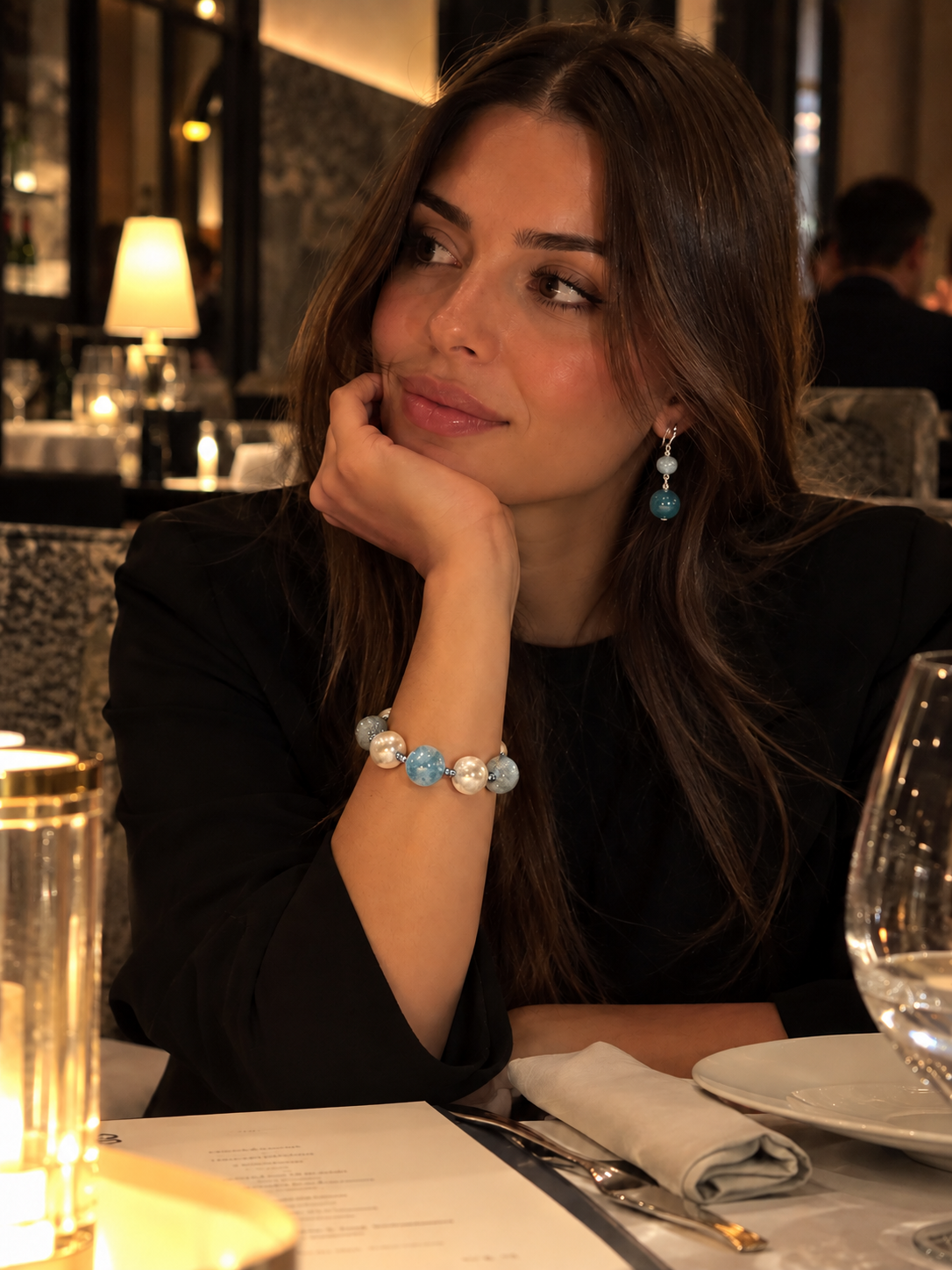
What Is Murano Glass Jewelry?
Murano glass jewelry is jewelry made with glass beads formed by hand on Murano, the small island in the Venetian lagoon where Venice moved its glass furnaces in 1291. The beads are the heart of the piece: they are strung or mounted with metal findings (clasps, hooks, spacers and chains) to make necklaces, bracelets and earrings.
You will also see the term Venetian glass jewelry. The two overlap: Venetian glass is the broader tradition of glassmaking in Venice and its lagoon, while Murano glass is the part of that tradition made on the island itself, where the craft has been concentrated for more than seven centuries. A genuine Murano glass bead is therefore always Venetian glass, but not every bead sold as "Venetian" was made on Murano, which is why the place of manufacture matters so much when you buy.
A Short History of Venetian Glass Beads
Venice has been making glass beads since the Middle Ages, and for centuries they were among its most valuable exports. Carried on merchant ships across the Mediterranean and far beyond, Venetian beads reached Africa, Asia and the Americas, where they were exchanged for gold, ivory and spices. Collectors still call them trade beads, and old examples are sought after today.
The most famous of them all, the multi-layered rosetta or chevron bead, is traditionally credited to Marietta Barovier, a member of one of Murano's oldest glassmaking families, in the late fifteenth century. Centuries later, in the nineteenth and early twentieth century, thousands of Venetian women known as impiraresse threaded tiny seed beads, the conterie, into strands by hand in the back streets of the city. The lampworked bead you wear today is the direct descendant of that long history.
How Murano Glass Beads Are Made
Most Murano glass jewelry is made with lampworked beads, known in Italian as perle a lume. The process has barely changed in principle over the centuries:
- Melting: the bead-maker softens a rod of coloured glass in a small, intensely hot flame (historically an oil lamp, which gave the technique its name; today a gas torch).
- Winding: the molten glass is wound around a thin steel rod called a mandrel, which will later form the hole of the bead.
- Shaping and decorating: turning the bead continuously in the flame, the maker rounds it, flattens it or draws it into a drop, then adds decoration with finer rods of glass, threads of colour, or leaf of gold and silver.
- Cooling: the finished bead is cooled slowly and evenly so that the glass does not crack, and only then released from the mandrel.
Because every bead is formed one at a time by hand, no two are ever exactly alike. Tiny variations in size, colour and pattern are not defects; they are the signature of the handmade.
Techniques You Will See in Murano Beads
- Gold and silver leaf: fine metal leaf trapped under clear or coloured glass gives beads their inner glow.
- Sommerso: one colour "submerged" in another, so the bead seems to hold light deep inside.
- Aventurine: a Venetian glass, developed in the seventeenth century, filled with tiny crystals of copper that sparkle when the light moves.
- Millefiori: slices of patterned glass canes, each showing a miniature flower, fused onto the surface. You can read more in our guide to millefiori glass.
For a wider look at the craft, see our overview of Murano glass techniques.
Necklaces, Bracelets and Earrings: What to Choose
Murano Glass Necklaces
Necklaces are where Murano glass has the most room to speak. Shorter styles sit close to the collarbone and frame the face, while long necklaces, about 70 cm in our collection, fall past the neckline and can be worn long or doubled into two strands, which makes one piece feel like two. Explore our Murano glass necklaces.
Murano Glass Bracelets
A bead bracelet is the easiest way to start: it is worn every day, it is seen every time you move your hands, and it pairs with almost anything. Most of our bracelets measure 18-20 cm, which fits the majority of wrists comfortably. Bold, full spheres make a statement on their own; lighter strands can be stacked two or three together in toning colours. Browse our Murano glass bracelets.
Murano Glass Earrings
Glass drop earrings catch the light with every movement of the head, and a pair of glass drops is light enough to wear comfortably through a long evening. Look for findings that are gentle on the skin: our pieces use nickel-free findings. See our Murano glass earrings.
Matching Sets
If you love a colour, a coordinated parure (necklace, bracelet and earrings from the same line) is the most elegant way to wear it, and one of the most generous gifts. Our Murano glass jewelry sets bring the pieces of a line together at a set price.
How to Choose the Right Colour
Murano glass comes in an almost endless palette, so let your wardrobe and your skin guide you:
- Blues and aquas (like the azure of our Positano line) are fresh and luminous, beautiful with white, navy and denim.
- Reds, ambers and golds (like the ruby glass of our Amalfi line, swirled with threads of warm gold) are warm and rich, made for evening and for warmer skin tones.
- Black and grey are the "little black dress" of glass: elegant, easy and impossible to get wrong.
- Rose and pearl tones flatter almost every complexion and soften any outfit.
- Multicolour pieces are joyful and summery, and they tie together a wardrobe of many colours.
Colours in Murano glass also carry centuries of symbolism; our guide to the meaning of Murano glass colors explains what each hue has traditionally represented.
How to Tell If Murano Glass Jewelry Is Authentic
Glass beads are the most imitated Murano product of all. Mass-produced beads made far from Venice are routinely sold as "Murano", often at tourist stalls and on large online marketplaces. These are the signs to check before you buy:
- Where exactly was it made? A genuine seller states clearly that the beads are made on Murano. Be wary of vague wording such as "Murano style", "Venetian style" or "Murano-type glass".
- Every bead is slightly different. Handmade beads vary a little in size, shape and pattern. Perfectly identical beads strung in long, uniform rows usually point to industrial production.
- The glass feels like glass. Real glass feels cool against the skin and noticeably heavier than plastic or resin of the same size.
- The price makes sense. Every bead takes a skilled maker's time at the flame. A bracelet of handmade Venetian beads cannot honestly cost a few euros.
- There is a certificate of authenticity. A reputable seller documents the origin of the piece and stands behind it.
Some furnaces also use Vetro Artistico® Murano, a collective trademark created by the Veneto Region to protect glass made on the island. Membership is voluntary, so the mark on a piece is a good sign, but its absence alone does not mean that a piece is fake. For a deeper look, read our guide on how to recognize authentic Murano glass and our authenticity commitment.
How to Wear Murano Glass Jewelry
- Let one piece lead. A bold necklace or statement bracelet looks most striking with simple clothes in a solid colour.
- Stack with intention. Two or three bracelets in toning colours, or one glass bracelet next to a fine metal bangle, feel curated rather than crowded.
- Double the long necklace. A 70 cm strand worn doubled becomes a fuller, shorter necklace for the evening.
- Think about the light. Glass comes alive in sunlight and candlelight; it is at its best at a dinner table or on a terrace.
- Match the metal. Silver-toned findings suit cool colours such as blue, grey and aqua; warm colours sit beautifully next to gold.
Caring for Your Murano Glass Jewelry
Glass does not tarnish and its colour does not fade, so with a little care Murano glass jewelry lasts for generations:
- Put it on last: after perfume, hairspray and body lotion, which can dull the metal findings and the stringing.
- Take it off first: before swimming, showering, exercise or cleaning.
- Store pieces separately in a soft pouch or their box, so that beads cannot knock against each other or against harder stones.
- Clean gently with a soft, dry cloth; never use abrasive products or ultrasonic cleaners.
- Mind hard surfaces: glass is durable in everyday wear, but a sharp knock on stone or tile can chip a bead.
Our care guide covers every type of Murano glass in more detail.
Murano Glass Jewelry as a Gift
Few gifts combine beauty, meaning and a genuine story as well as a piece of Murano glass jewelry. It is personal without needing to fit perfectly, it travels easily, and it carries the romance of Venice in a way anyone can understand. Bracelets are the classic first gift, a long necklace feels generous, and a matching set is a gift for a milestone. Every piece from us is shipped in protective luxury packaging and comes with a certificate of authenticity. For more ideas, browse our Murano glass gifts under €100 or our complete gift ideas.
Frequently Asked Questions
Is Murano glass jewelry made of real glass?
Yes. Authentic Murano glass jewelry is made with real glass beads, shaped by hand in a flame on the island of Murano. Plastic, resin or acrylic beads are never Murano glass, whatever the label says.
How can I tell if my Murano glass jewelry is real?
Check that the seller names Murano as the place of manufacture, that the beads vary slightly from one another, that the glass feels cool and heavy, and that the piece comes with a certificate of authenticity. An extremely low price is the most common warning sign.
Is Murano glass jewelry fragile?
It is more durable than most people expect and perfectly suited to everyday wear. Like any glass, a bead can chip if it is dropped on a hard floor or knocked against stone, so store your pieces separately and take them off for sport.
Can I wear Murano glass jewelry in the shower or the sea?
The glass itself is not harmed by water, but the metal findings and the stringing last longer if they stay dry. We recommend taking your jewelry off before showering, swimming or bathing in the sea.
Is Murano glass jewelry suitable for sensitive skin?
Glass does not react with the skin. What matters is the metal of the findings; ours are nickel-free, avoiding nickel, the most common cause of skin reactions.
What is the difference between Murano glass and Venetian glass jewelry?
Venetian glass is the broader glassmaking tradition of Venice and its lagoon; Murano glass is made on the island of Murano itself, where Venice's furnaces have been concentrated since 1291. Genuine Murano glass is always Venetian, but not everything sold as "Venetian" was made on Murano.
How much does Murano glass jewelry cost?
In our collection, handmade Murano glass bracelets start at €60, long necklaces at around €120, and matching sets cost more depending on the number of pieces. Mass-produced imitations cost far less, which is often the clearest sign that they are not the real thing.
Discover Our Murano Glass Jewelry
Every piece in our Murano glass jewelry collection is made with beads lampworked by hand on the island of Murano, finished with nickel-free findings, shipped worldwide with insured delivery, and accompanied by a certificate of authenticity. Explore the necklaces, bracelets, earrings and matching sets, and find the piece of Venice you want to wear every day.
Discover Our Handcrafted Collection
Every piece is created by master artisans on the island of Murano, Venice — and accompanied by a certificate of authenticity.
Explore the Collection