
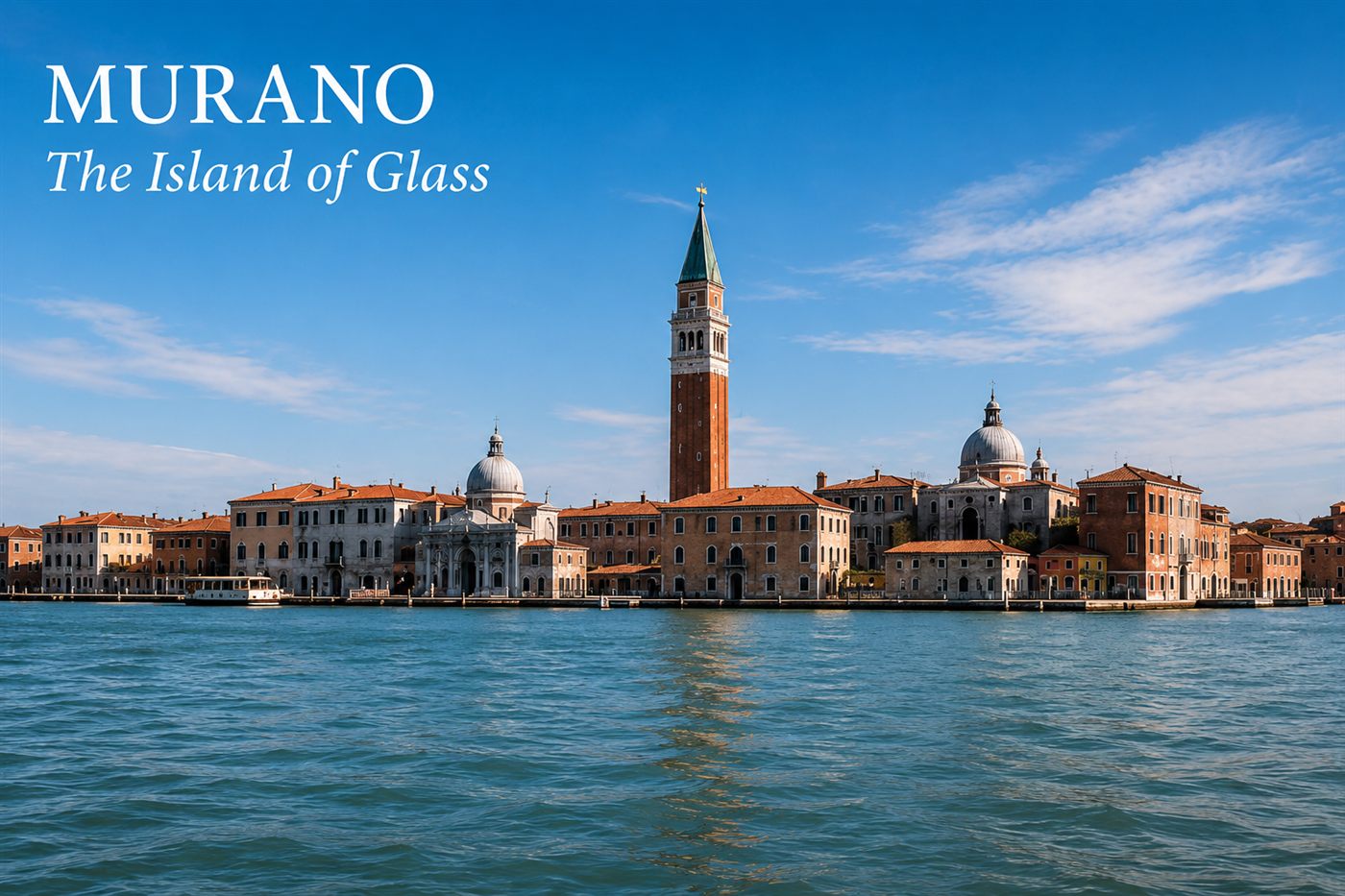
How to Get to Murano from Venice: The Complete Guide
Murano lies barely a mile and a half north of Venice across the open lagoon, yet it is a world of its own - the island that has shaped the history of glass for over seven hundred years. There is no bridge and no road to Murano; every visit begins on the water. This guide covers every practical way to get there, what it costs, how long it takes, which vaporetto stop to choose depending on what you want to see, and how to combine Murano with Burano and Torcello for a full day in the lagoon.
Quick Answer
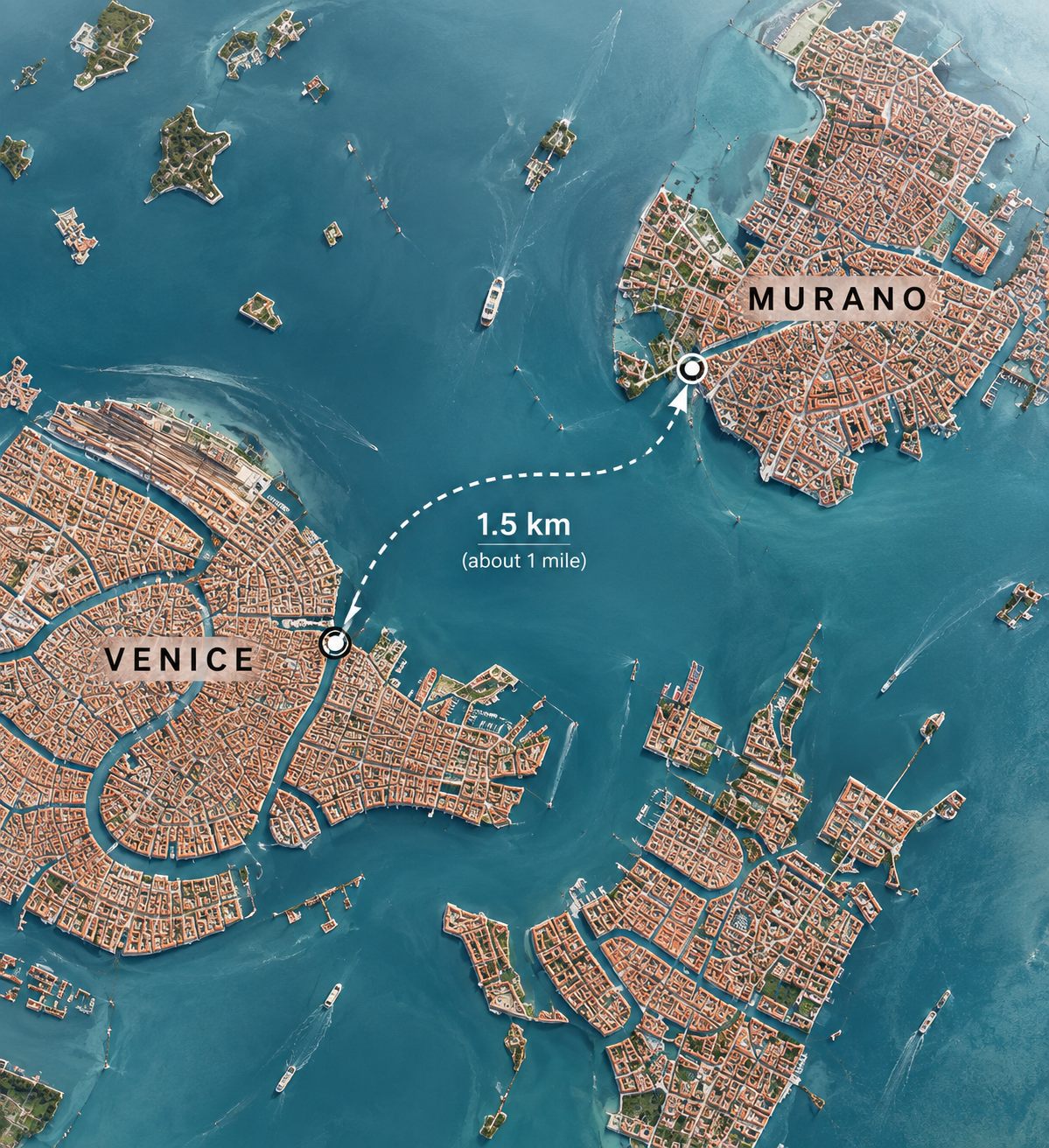
Murano sits just 1.5 km (about 1 mile) from Venice. The closest and fastest crossing is the ACTV vaporetto from Fondamenta Nove - about 10 minutes. The cheapest option is a standard ACTV ticket (€9.50, or a multi-day pass for island-hopping); the fastest door-to-door option is a private water taxi (10–20 min, €70–150).
Where Is Murano, Exactly?
Murano is not a single island but a small archipelago of five islets in the Venetian Lagoon, separated by canals and linked to each other by bridges - a miniature Venice in its own right, with its own Grand Canal (the Canale degli Angeli / Canale di San Donato) running through the centre. It sits roughly 1.5 km (about 1 mile) north-east of the historic centre of Venice, and about 1 km south of the airport side of the lagoon. Because it is a separate set of islands, reaching it always means a boat - public vaporetto, water taxi, private boat, or an organised tour.
The Main Way to Get There: ACTV Vaporetto (Public Waterbus)
For the vast majority of visitors, the public vaporetto operated by ACTV (Venice's public transport company) is the simplest, cheapest and most reliable way to reach Murano. Several lines serve the island; which one you take depends on where you are starting from in Venice.
From Fondamenta Nove (the closest departure point)
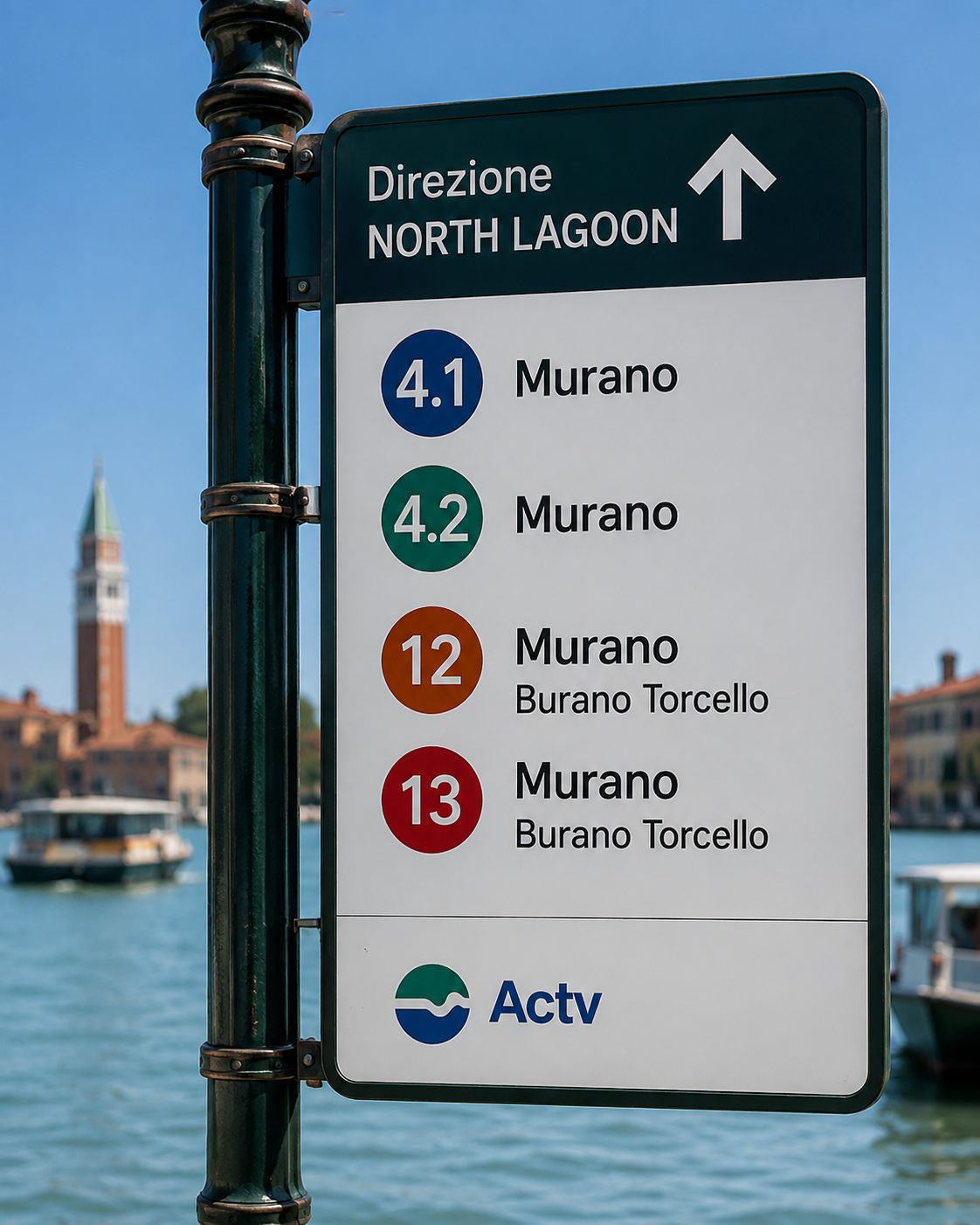
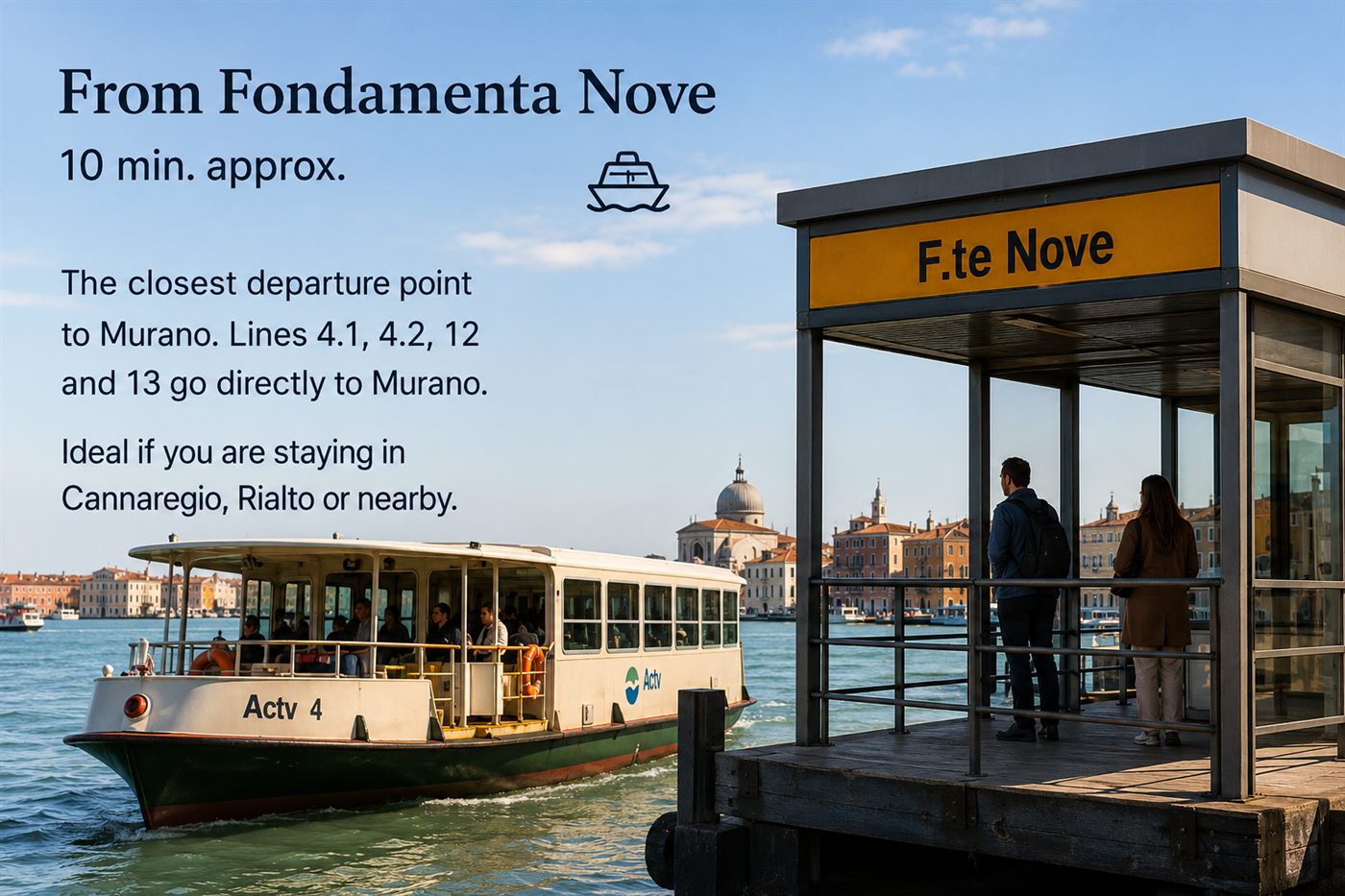
Fondamenta Nove, on the northern edge of the Cannaregio district, is the closest mainland departure point to Murano and the one most Venetians use themselves. From here the crossing takes only about 10 minutes. Several lines depart from Fondamenta Nove and stop at Murano, including the circular lines 4.1 and 4.2, and lines 12 and 13, which continue on to Mazzorbo, Burano, Torcello and the northern lagoon islands. If you are staying anywhere near Cannaregio, Rialto or the train station, walking or taking a land route to Fondamenta Nove first is usually the fastest option overall.
From Piazzale Roma or the Santa Lucia Train Station
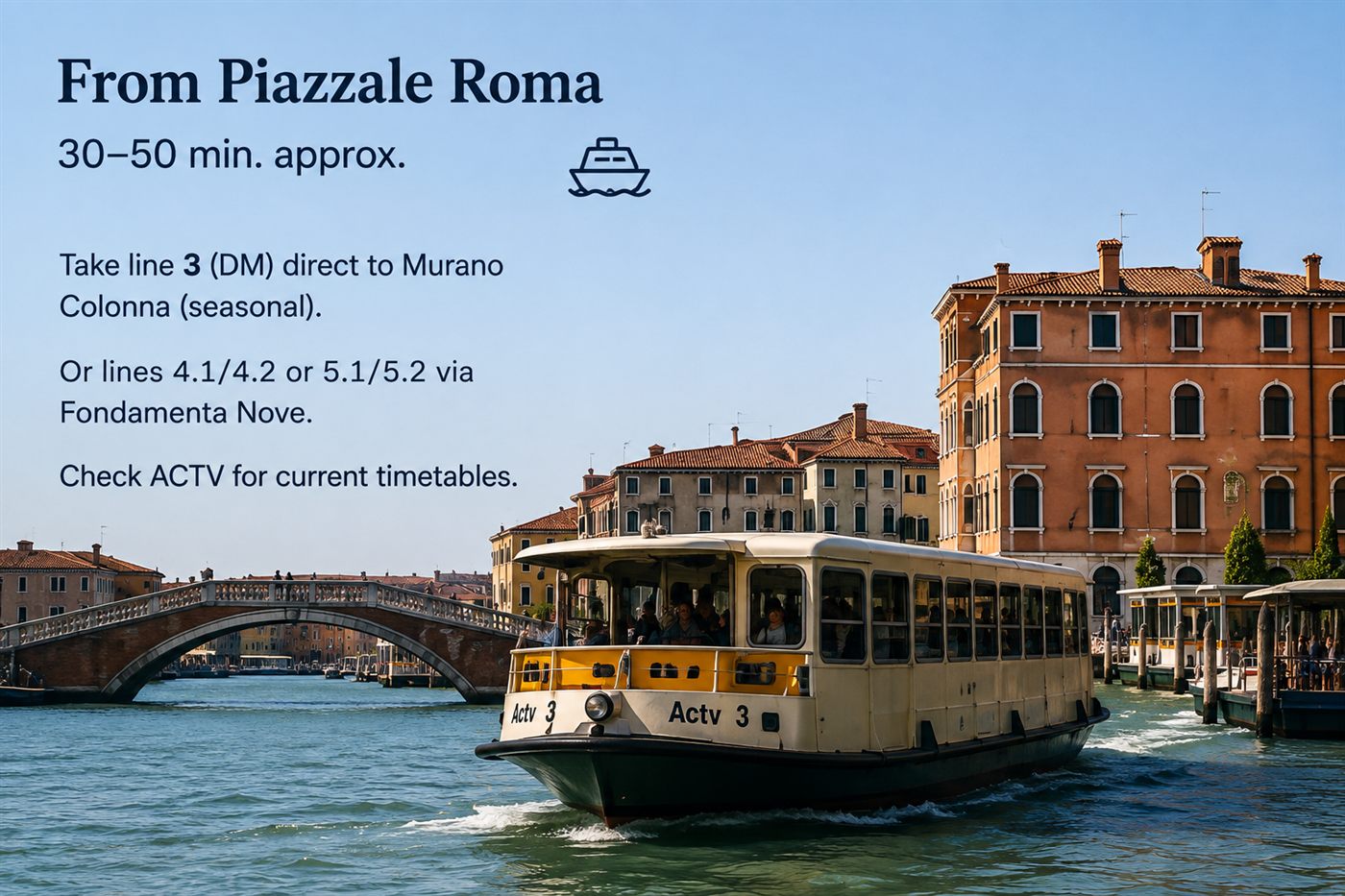
If you are arriving by car, coach or train, you will land at Piazzale Roma or the Ferrovia Santa Lucia train station, at the western end of Venice. The direct line historically used for this route is line 3 ("DM" - Diretto Murano), a faster service that runs (seasonally and on a timetable that can change year to year) straight from these stops to Murano's Colonna landing in around 30 minutes without weaving through the Grand Canal. When line 3 is not in service, the alternative is to take a line 4.1/4.2 vaporetto around to Fondamenta Nove and change there, or catch line 5.1/5.2 style routes that circle the edge of Venice - the total journey by this route typically takes 35-50 minutes. Because ACTV adjusts line numbers and seasonal timetables from time to time, it's always worth double-checking the current routes on the official ACTV website or the AVM Venezia app before you set off.
From San Marco / Riva degli Schiavoni
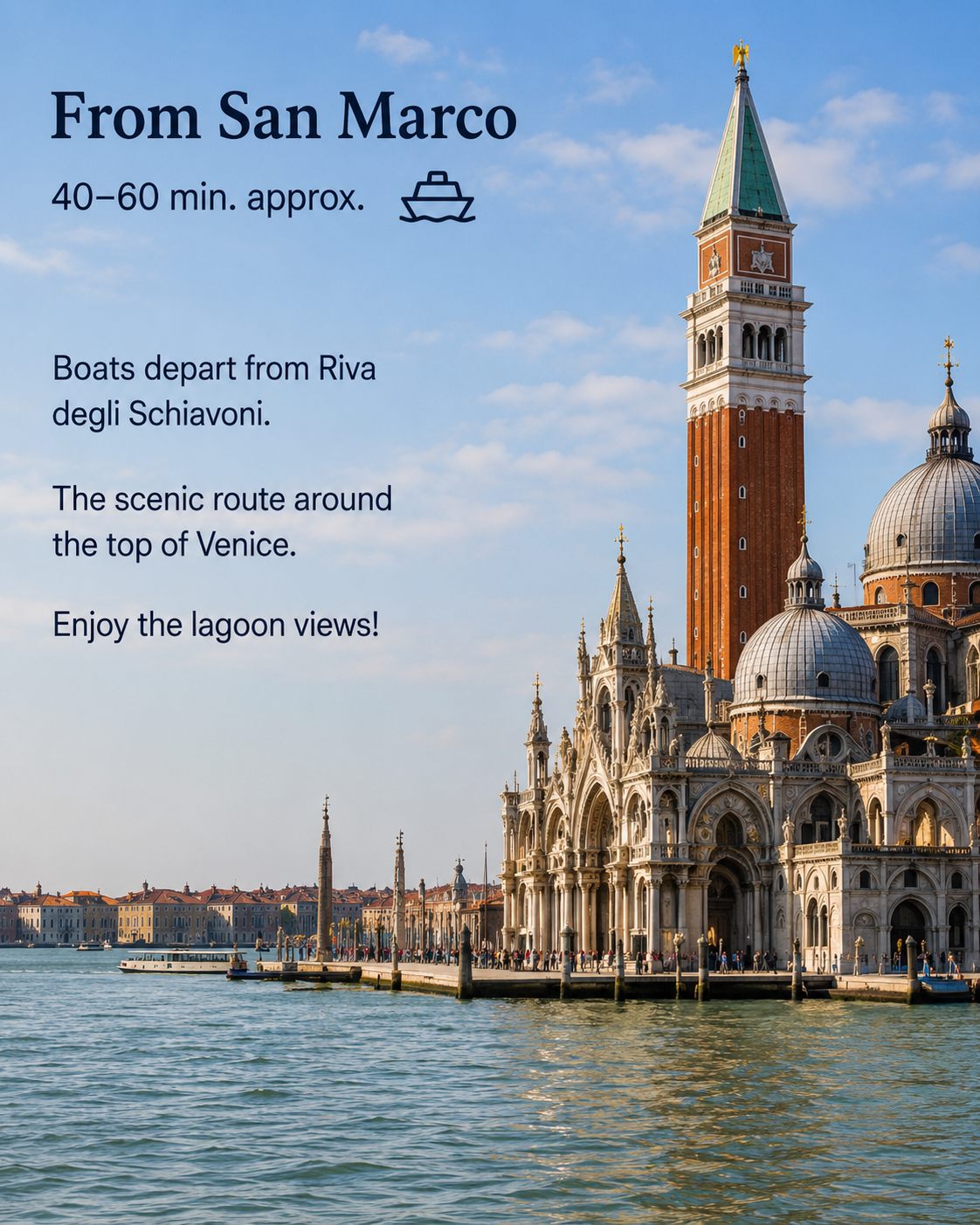
From the San Marco area, the journey to Murano takes longer, as the boat has to skirt the entire top of Venice. Expect around 40-60 minutes depending on the line and number of stops. This is the departure point most commonly used by the organised "three islands" boat tours described below.
From Marco Polo Airport: The Alilaguna Water Bus
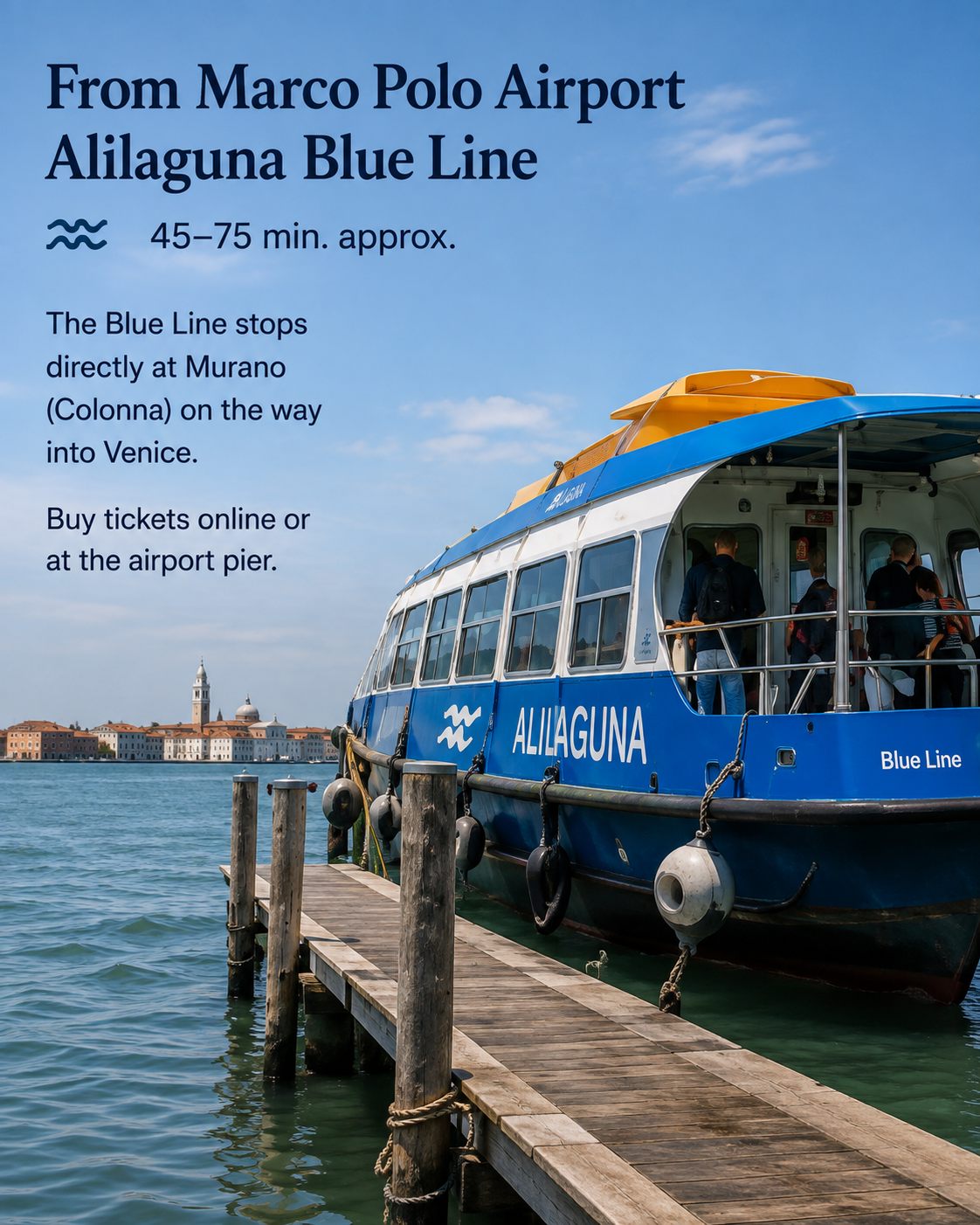
If you are arriving by air, you do not need to go into central Venice first. The Alilaguna water bus company runs directly from Marco Polo Airport into the lagoon, and the Blue Line (Linea Blu) stops directly at Murano (Colonna) on its way into Venice. This is a genuinely convenient option for travellers heading straight to the glass furnaces, or for anyone building Murano into the start or end of a Venice trip. Journey time from the airport pontoon to Murano is roughly 45-75 minutes, depending on how many stops the boat makes along the route; tickets can be bought online in advance or at the airport pier.
Water Taxi: The Fastest, Most Direct Option
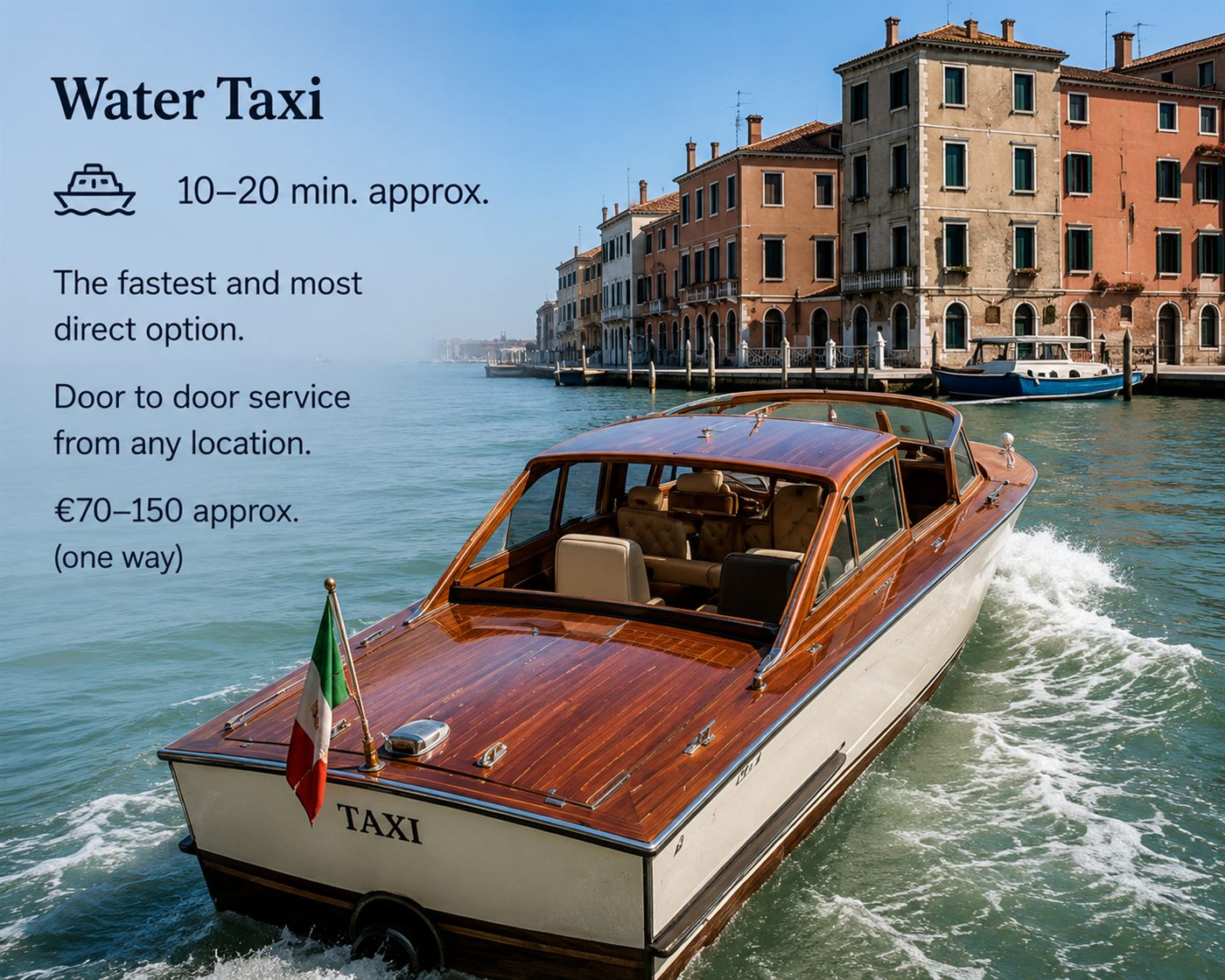
A private water taxi (motoscafo) will take you from almost anywhere in Venice - your hotel dock, the airport, the train station - directly to Murano's canal-front, door to door, with no changes and no walking. It is by far the fastest and most comfortable option, particularly useful if you are travelling with luggage, in a group, or on limited time. It is also the most expensive: expect a price in the broad range of roughly €70-150 for a one-way transfer depending on the pickup point, time of day and number of passengers, agreed with the operator or booked in advance - always confirm the fare before boarding.
Organised Boat Tours: Murano, Burano & Torcello
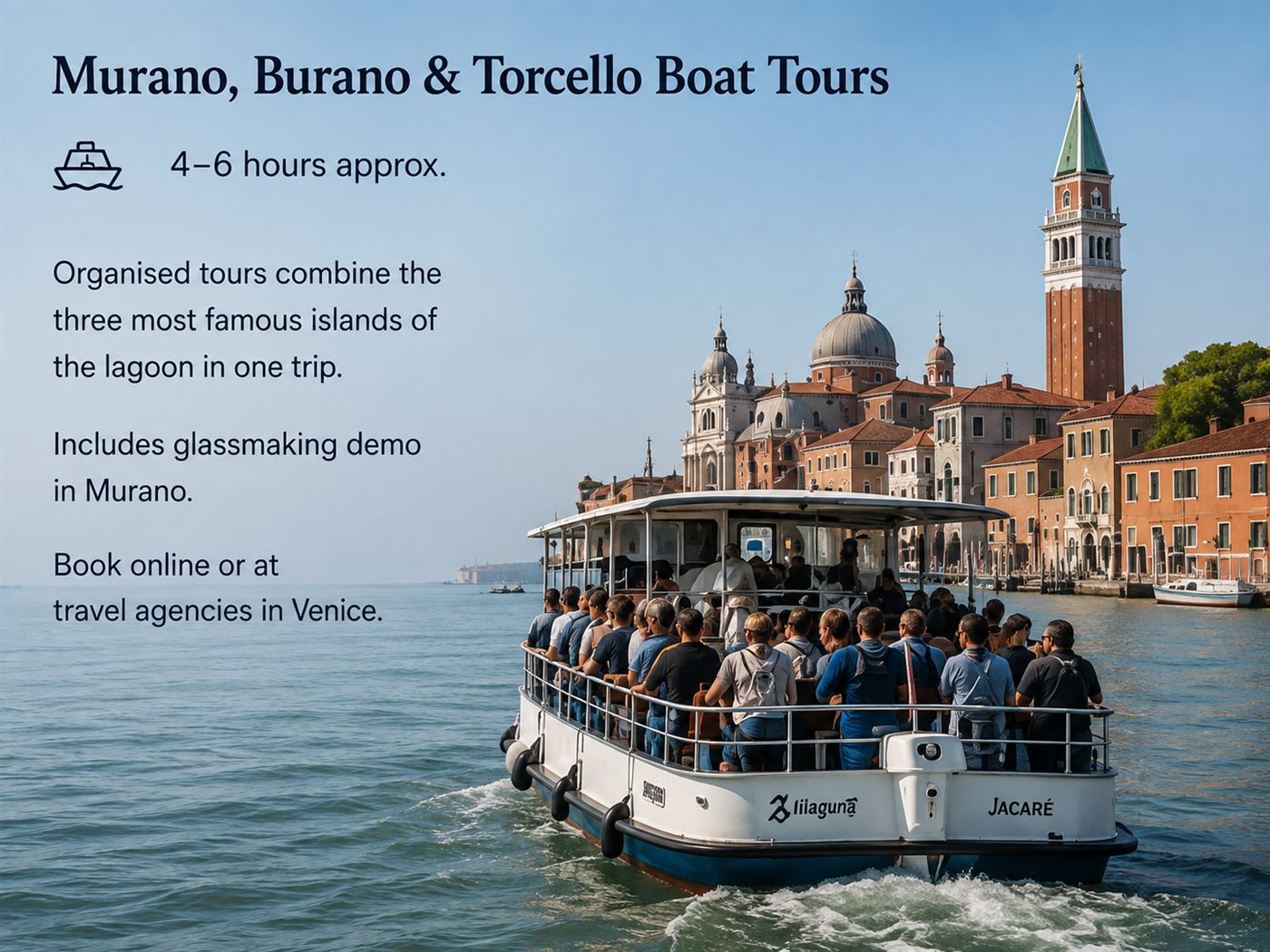
Countless operators run half-day and full-day "three islands" tours that combine Murano, Burano and Torcello in a single guided boat trip, typically departing from San Marco or Fondamenta Nove and lasting 3.5-5 hours in total. These are a convenient option if you would rather not work out vaporetto lines yourself, and most include a stop at a working glass furnace on Murano with a live glassblowing demonstration. The trade-off is less flexibility and time on each island than travelling independently by public vaporetto.
Can You Walk to Murano?
No - there is no bridge or causeway connecting Murano to the historic centre of Venice, so walking there is not possible; the crossing must be made by boat. Once you arrive, however, Murano itself is entirely walkable: its five islets are linked by pedestrian bridges, and the main street, Fondamenta dei Vetrai, running alongside the Rio dei Vetrai canal, can be walked end to end in about fifteen minutes, passing the majority of the island's glass showrooms and furnaces along the way.
Vaporetto Tickets and Prices
Prices and fare rules are set by ACTV and do occasionally change, so treat the figures below as a general guide and check actv.avmspa.it or the AVM Venezia app for current prices before you travel.
- Single ticket: at the time of writing, a standard ACTV vaporetto ticket costs around €9.50 and is valid for 75 minutes from validation, including transfers between lines within that window - useful if your route to Murano requires a change.
- Multi-day travel passes: if you plan to island-hop (Murano, Burano, Torcello, the Lido) or are staying several days, a 24-, 48-, 72-hour or 7-day ACTV pass works out significantly cheaper than buying single tickets each time.
- Venezia Unica City Pass: a combined pass that bundles public transport with museum and attraction entry, worth considering if you're also visiting sights like the Murano Glass Museum.
- Alilaguna tickets: priced separately from ACTV, typically higher than a standard vaporetto ticket given the longer airport route; single and return fares are available.
Always validate your ticket at the small electronic reader on the landing stage before boarding, even if you already hold a physical ticket or a travel pass - an unvalidated ticket is treated as if you never bought one, and inspections do happen.
Which Vaporetto Stop Should You Get Off At?
Murano has several landing stages, and choosing the right one saves you a lot of walking depending on what you're there to see:
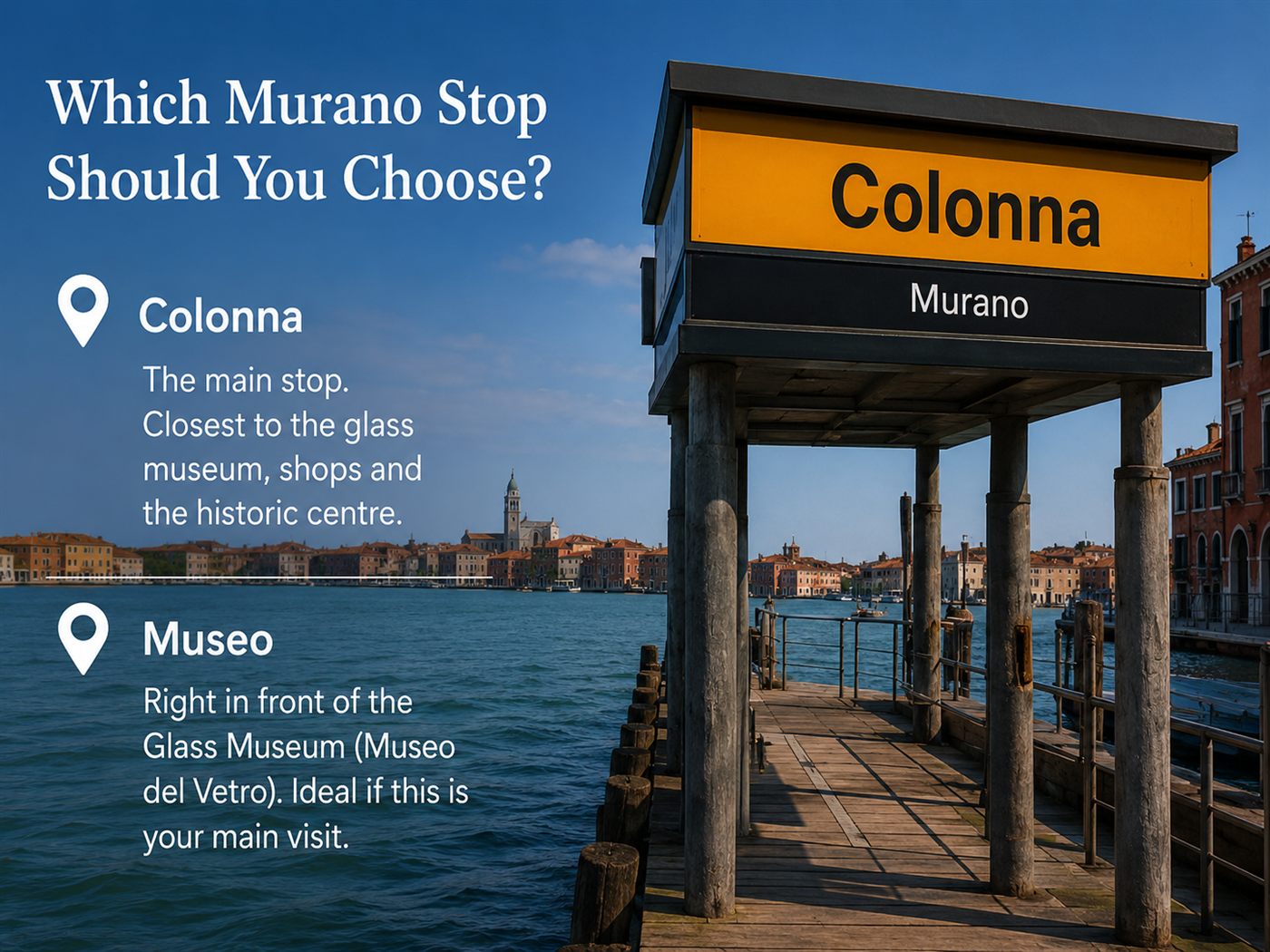
- Colonna: the main and busiest stop, right at the mouth of the island's Grand Canal - the best choice for the glass showrooms and furnaces along Fondamenta dei Vetrai, and the stop served by both the direct line 3 and the Alilaguna Blue Line.
- Museo: the closest stop to the Museo del Vetro (Glass Museum) inside Palazzo Giustinian, and a good base for exploring the quieter Fondamenta Giustinian side of the island.
- Navagero and Venier: smaller stops further along the main canal, convenient if your furnace or hotel is on that stretch.
- Faro: at the far end of the island near the lighthouse (faro), a quieter, more residential corner worth a look if you want to see Murano beyond the tourist strip.
- Da Mula: on the southern side, a useful stop if you're arriving from the Burano/Torcello direction on line 12 or 13.
Combining Murano with Burano and Torcello
Because lines 12 and 13 continue from Murano on to Mazzorbo, Burano and Torcello, it's entirely possible - and popular - to visit all three islands in a single day. A typical independent itinerary: an early departure from Fondamenta Nove to Murano (arriving before the mid-morning crowds), two to three hours exploring the glass workshops and the Glass Museum, then back on the vaporetto to Burano for its famously colourful houses and lace-making tradition, and finally a short additional hop to Torcello - the oldest and quietest of the three, with its ancient Byzantine cathedral - before returning to Venice in the late afternoon. Because a standard 75-minute ticket won't cover a full day of island-hopping, a multi-day travel pass is usually the better value option for this kind of itinerary.
Things to Do in Murano
Once you've made the crossing, here's how to make the most of the island:

- Visit a glass factory: see a live glassblowing demonstration - the heart of any trip to Murano, and the closest most visitors will ever get to watching a seven-century-old craft in motion.
- Explore the Glass Museum: the Museo del Vetro, inside the Gothic Palazzo Giustinian, traces the island's history from Roman glassmaking to the present day.
- Walk the canals and bridges: away from Fondamenta dei Vetrai, Murano's smaller canals and quiet campi are some of the most peaceful corners of the entire lagoon.
- Shop authentic Murano glass: look for the "Vetro Artistico® Murano" trademark, and ask for a certificate of authenticity with any piece you buy.
- Try the local cuisine: several trattorias along the canals serve fresh lagoon seafood with views that rival anything in central Venice - without the crowds.
Practical Tips for Visiting Murano
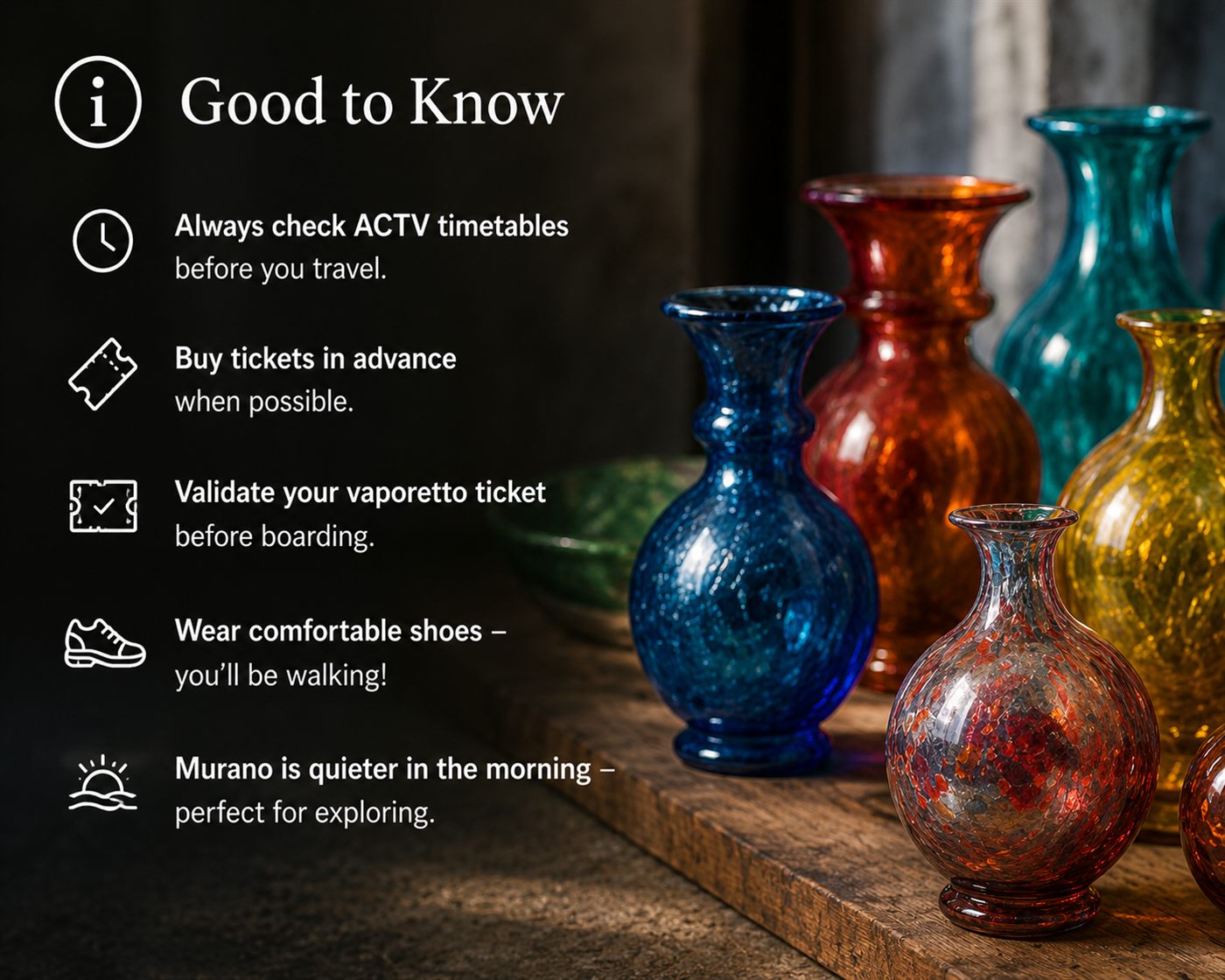
- Go early or late: Murano is at its busiest from mid-morning to early afternoon, when day-trip and cruise groups arrive in waves. An early crossing (before 10am) or a late-afternoon visit means quieter streets, better light for photography, and more relaxed conversations with the maestros in the furnaces.
- Buy tickets in advance where possible: the AVM Venezia app and the ACTV website let you buy and validate tickets digitally before you reach the dock, saving time at busy stops like Fondamenta Nove and Piazzale Roma.
- Track your boat in real time: the AVM app shows live vaporetto arrivals, which is genuinely useful given how frequently queues form at peak times.
- Mind your luggage: vaporettos have limited space for large suitcases, and boarding can be a squeeze at busy stops - if you're travelling with heavy luggage straight from the airport or station, a water taxi is far more comfortable.
- Wear comfortable shoes: between the vaporetto stops and the island's own streets, you'll be walking more than you expect.
- Accessibility: most main ACTV lines and landing stages are wheelchair accessible with level boarding, though it's worth checking the specific line and stop in advance, as not every smaller stop is equally equipped.
- Watch for the free furnace demonstrations - and the sales pitch: many showrooms offer a free live glassblowing demonstration to visitors; there's no obligation to buy, though you will usually be shown through a shop afterwards.
Frequently Asked Questions
How long does it take to get from Venice to Murano?
It depends entirely on your starting point: about 10 minutes from Fondamenta Nove, roughly 30-50 minutes from Piazzale Roma or the train station, and 40-60 minutes from San Marco. A private water taxi is faster and more direct from any of these points.
Can I walk to Murano from Venice?
No. There is no bridge connecting Murano to the historic centre of Venice - the crossing must be made by boat, whether public vaporetto, water taxi or organised tour.
What is the cheapest way to get to Murano?
The ACTV public vaporetto is by far the cheapest option, especially if you buy a multi-day travel pass and combine the trip with other lagoon islands or attractions.
What is the fastest way to get to Murano?
A private water taxi is the fastest door-to-door option. Among public transport options, departing from Fondamenta Nove is the quickest crossing at around 10 minutes.
Can I visit Murano, Burano and Torcello in one day?
Yes, and it's a popular full-day itinerary. Vaporetto lines 12 and 13 connect all three islands, so with an early start you can comfortably see all of them and be back in Venice by evening.
Do I need to book vaporetto tickets in advance?
It's not usually required outside peak summer periods, but buying and validating your ticket digitally through the AVM app before you reach the dock saves time and avoids queues at busy stops.
Is Murano worth visiting?
For anyone interested in glass, craftsmanship or simply a quieter, more local corner of the lagoon than central Venice, yes - Murano has been the centre of the world's finest glassmaking for over seven centuries, and the furnaces, the Glass Museum and the island's own canals and campo make it well worth the short crossing.
Bring a Piece of Murano Home
If a trip to the furnaces isn't in your plans right now, you can still bring home an authentic piece of the island's seven-hundred-year tradition. Every piece in our Murano glass collection is hand-blown by master artisans on Murano itself, shipped worldwide fully insured, and comes with a certificate of authenticity - so wherever you are, a genuine piece of Venetian glassmaking is only ever a short journey away.
Discover Our Handcrafted Collection
Every piece is created by master artisans on the island of Murano, Venice — and accompanied by a certificate of authenticity.
Explore the Collection